The BBC should be better than this.
Fergus Murray, Dec 26, 2025, (reposted from oolong.medium.com)
As a science educator, I’m quite sensitive to people abusing scientific language to lend a veneer of credibility to things. I can live with Star Trek writers looking to paper over plot holes with technobabble, but I draw the line at pseudoscience used in service of regressive politics. You do not get to pretend your bigotry is somehow based on science.
The use of ‘biological male’ to describe trans women is one such abuse of scientific language. It dishonestly implies that biology says trans women are male, when science says no such thing. Its uncritical use by, first, the UK Supreme Court, and now (repeatedly) by the BBC, gives us reason to doubt the impartiality of both.
Neither sex nor gender is scientifically simple, and neither are they identical. Let’s start with sex: the biological side of maleness and femaleness.
The first thing to note is that sex is not a binary category — in other words, it is not something that comes in exactly two varieties. Most animals (including humans) and quite a few plants have a cluster of traits that it’s convenient to file under either ‘male’ or ‘female’, and most of the time these traits line up, but not always. There are genetic, hormonal, physiological, anatomical and reproductive aspects. Each of these can vary separately from the others, even though they are all biologically linked. They might be different from birth (which makes someone intersex) or thanks to modern medicine (through the gender-affirming treatments received by many trans people). It might be both — indeed, there is some reason to think that for at least some trans people, their gender identity is rooted in neurobiological differences.
The Supreme Court, in its judgement in For Women Scotland Vs Scottish Ministers (2025), ruled that for the purposes of the Equality Act 2010, ‘sex’ and ‘gender’ should be interpreted to mean ‘biological sex’. They did not make any attempt to clarify what they thought that meant; they seemed to think it’s obvious, which suggests they never asked a biologist. It looks like what they actually meant is what was put on someone’s birth certificate when they were a baby, but it’s hard to be sure.
The ‘biology’ involved in determining someone’s sex at birth (or assigning their gender) is nothing more than a quick genital inspection. For most people that’s fine, but UK law has long acknowledged that it doesn’t work for everyone — although unlike some jurisdictions, we have never legally recognised the possibility of anything beyond male and female. Intersex people’s birth certificates can be amended, when further development doesn’t match medical professionals’ first guess.
Trans people have had the right to amend their birth certificates for more than twenty years, by virtue of a Gender Recognition Certificate (GRC). The Gender Recognition Act 2004 introduced this right after the European Court of Human Rights ruled that trans people’s rights to privacy and family life were being violated by keeping them in a legal grey area; a GRC was supposed to mean that “the person’s gender becomes for all purposes the acquired gender”. The Supreme Court’s 2025 ruling assumed that the Equality Act passed six years later quietly created major exceptions to this, which seemingly went unnoticed for fifteen years.
Returning to the question of biology, when the hormonal and anatomical features associated with sex can be transformed medically, it is wilfully misleading to suggest that this has no impact on biological sex. Anyone with more than the most basic understanding of biology will recognise living things change over time, and that biological categories are often complicated. A trans woman’s body can share many sex-associated features in common with a cis woman; likewise trans and cis men. Trans women often grow breasts thanks to their ‘female’ hormones, for example; trans men regularly grow beards. These are biological facts, and socially significant ones.
That brings us on to gender: the social and psychological aspects of maleness and femaleness. How someone is treated in our sexist society depends on how they are seen — whether people who meet them think they’re looking at a man, a woman or something else, and also how well they are seen to be ‘performing’ that gender. Medical sexism remains an enormous problem, but the fact is that in most other contexts, sexism is based on social perception rather than biology. Competent scientists recognise the need to study sex and gender. The BBC’s stock formulation, “a biological male who identifies as a woman”, deliberately glosses over the fact that there is far more to being trans than just how you identify: trans women generally live their lives as women.
Science clearly doesn’t justify the description of trans women as ‘biological males’. Doing so is a political decision, and it is one that has been driven by anti-trans campaigning groups like Sex Matters. It is a ‘dogwhistle’: something that signals agreement with a certain worldview, without coming right out and saying so.
One of the things about dogwhistles is that they are sometimes used in ignorance of what they imply. That’s crucial — if nobody ever used them unknowingly, they would no longer provide the plausible deniability that bigots treasure. So somebody using the phrase ‘biological male’ is not necessarily a fully signed up anti-trans campaigner, but an institution like the BBC has no excuse for not knowing how large segments of its audience will interpret phrases like this. Either they are deliberately signalling their alignment with anti-trans campaigners, or they are doing so negligently.
In response to my complaint the first time I noticed the BBC using this phrasing, they sent a stock reply including this claim:
BBC News doesn’t believe that the language used in this article amounts to taking sides, in an area with strongly held and sometimes incompatible views.
Perhaps this is their sincerely held belief, but they are wrong. They add:
We value knowing when audience members have been disappointed with any aspect of our reporting and appreciate your feedback, which has been discussed with senior editors, recorded on our overnight reports and circulated widely.
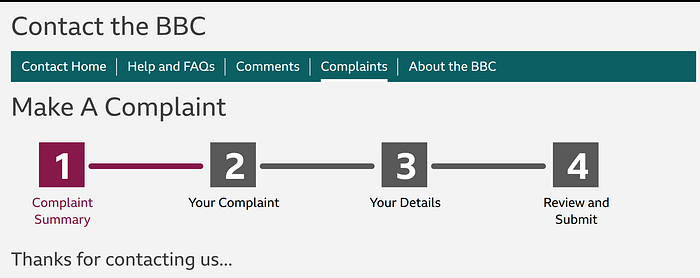
With that in mind, you might like to know that the BBC Complaints form is here. You might also like to use the Media Complaints Collector tool to allow the Trans Advocacy and Complaints Collective (TACC) to track complaints and how they are handled.
When I first complained in early December, I already suspected that they had actually introduced editorial guidelines recommending the use of this dogwhistle. This has since been confirmed, and many articles on their site now use this pejorative and unscientific phrasing. They are of course in a difficult position, with a well-funded and carefully manufactured international moral panic on the one side and a small, marginalised minority on the other. Their failure to find a respectful balance between these two forces suggest they have decided to cave to the former.
Postscript: the TACC have already written to the BBC Board & Editors (who sent this lousy reply), the Women & Equality Committee at Westminster, and two relevant ministers about the BBC’s ongoing failures of impartiality regarding trans people.
 Resisting Transphobia in Edinburgh