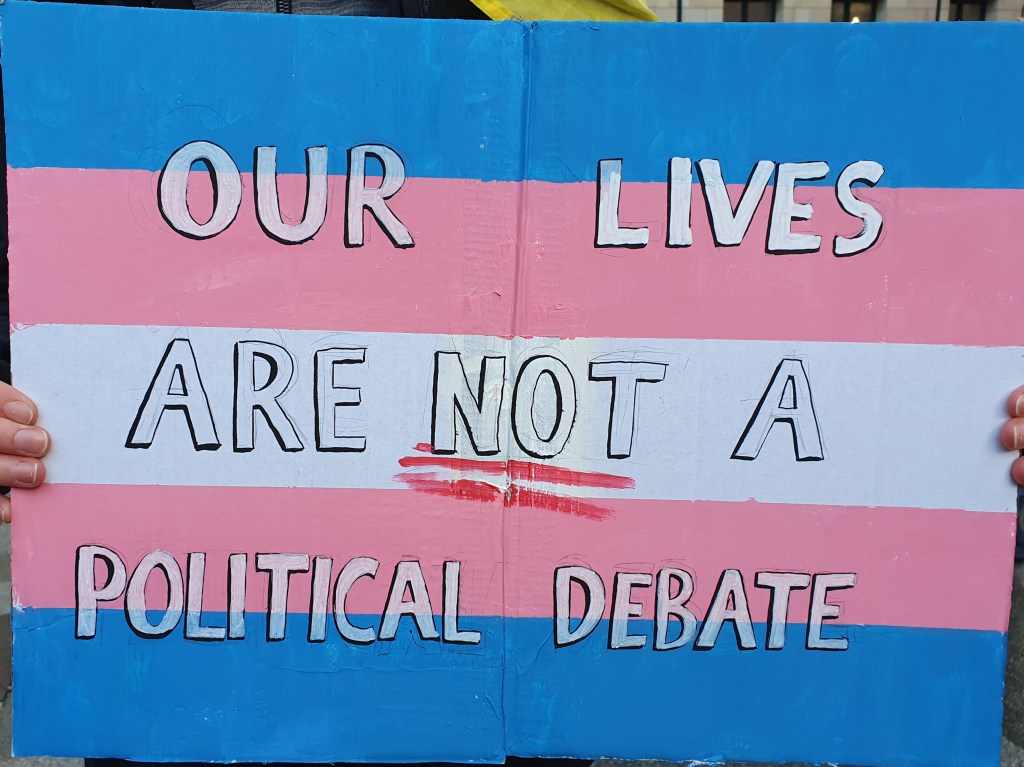
It’s been a bad week of politics for queer people. It’s been a bad week of politics for trans people. It’s been a bad week of politics for anyone with a moral backbone or an ounce of care for other people. It’s been a bad week; but not the only week.
The National
In September 2023, the Scottish Government launched their legal challenge against the blocking of the Gender Recognition Reform Bill (see RTiE’s summary of that here). Almost three months later, Lady Haldane has ruled that the action taken by the Conservative government in Westminster was lawful.
While the result is maddening, it is also predictable.
As explained in section 73 of the judgement, the role of the Secretary of State for Scotland was to prove whether the GRR Bill would have “any adverse effects on reserved matters”. Haldane remains neutral on the ethical issues of self-ID throughout, but focuses on the core question: did the UK Government have the lawful right to block the Bill?
In making this judgement, the court has concluded that Westminster does have this right. By doing so, they lead us to the conclusion that self-sovereignty and devolution within Britain are, and always have been, at risk – the precedent has been set now that, should they so choose, the UK Government has free reign to block the decisions of external, devolved and elected governments.
In an email to members of the Scottish Greens this afternoon, Maggie Chapman called the judgement “a crushing blow for equality [and] an attack on our Parliament and on our democracy”. In reference to the ever-failing Rwanda Bill, Rishi Sunak released a statement saying, “Our Parliament is sovereign, and it should be able to make decisions that cannot be undone in our courts”.
No further comment is needed…
The International
On 30 November, the Supreme Court of Russia declared the LGBT movement an extremist organisation. The following day, several gay clubs in Moscow were raided by the police in an apparent and imminent crackdown on queer behaviour and culture.
In a rare show of solidarity with queer people, the LGB Alliance posted a message calling out the “homophobia and transphobia” on display in the country. The group’s replies were inundated with calls for cancellation by their usual bigoted supporters, shocked to find out that the group (or its social media manager anyway) might not want to see Section 28 reenacted on a grand scale.
The LGB Alliance has done little to support lesbians; little to support gay people; little to support bisexuals – and yet they still have the support of these “allies”. Their supporters clearly care not about helping those groups, but only about keeping trans people down.
The Good News
Another (more positive) change in stance towards trans people comes from long-distance swimmer Diana Nyad, who had previously written against the inclusion of trans women on women’s teams. She has joined a long line of athletes standing by the science, the opinions of experts, and her trans siblings: “I now see how all women are negatively affected by the ways transgender women are targeted by discrimination and abuse in sports and elsewhere”.
In the 1992 edition of Jay and Young’s Out of the Closets, the Chicago chapters of Third World Gay Revolution and Gay Liberation Front wrote the following:
“[G]ay liberation doesn’t depend on our public relations job with straights. To get some rights granted by our oppressor is not gay liberation. To persuade society to tolerate a bit more unhassled deviation within the framework of sexism is not gay liberation.”
If queer people (trans or otherwise) are going to have the ability to be themselves – to be free from oppression – that ability is not going to come from the UK Government. That ability is not going to come from the Supreme Court of Russia. That ability is not going to come from the faceless bigots opposing calls of solidarity on social media.
That ability can only come from queer people fighting for themselves and standing up for themselves. As the groups above said: “Gay liberation is inherently revolutionary”.
References
- https://www.theguardian.com/politics/2023/dec/08/scottish-court-rules-uk-government-veto-of-gender-recognition-bill-lawful
- https://www.scotcourts.gov.uk/docs/default-source/cos-general-docs/pdf-docs-for-opinions/2023csoh89.pdf
- https://www.bbc.co.uk/news/world-europe-67565509
- https://www.bbc.co.uk/news/world-europe-67601647
- https://www.thepinknews.com/2023/12/04/lgb-alliance-anti-transphobia-tweet
- https://www.out.com/out100/groundbreakers/diana-nyad
- K. Jay and A. Young, Out of the Closets: Voices of Gay Liberation (1992, New York University Press), pp. 252-258.
 Resisting Transphobia in Edinburgh